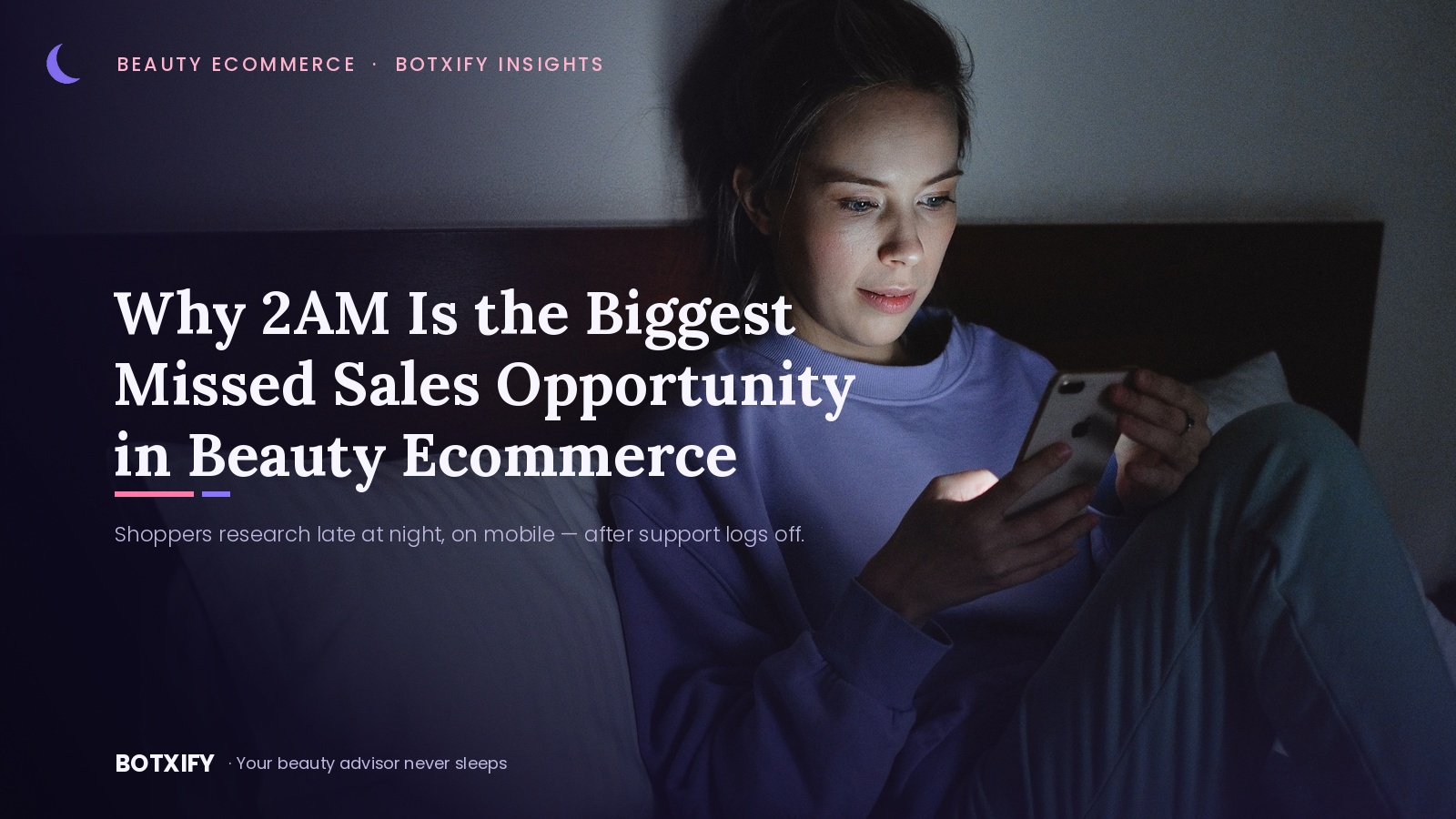
Why 2AM Is the Biggest Missed Sales Opportunity in Beauty Ecommerce
Your support hours probably look like everyone else's: a chat widget staffed roughly 9 to 6, maybe with a "leave a message" fallback after that. It's a reasonable schedule for a team. It's a strange schedule for a beauty store, because it has almost nothing to do with when your shoppers are actually deciding whether to buy.
Skincare and haircare research doesn't happen on a 9-to-6 clock. It happens after dinner, mid-routine, alone, on a phone. That's not a guess — it's what the timing and device data for this category actually shows.
When beauty shoppers actually decide to buy (not 9-to-5)
Start with the routine itself. In a 2023 Drive Research survey of 1,004 skincare users, 74% said they follow both a morning and an evening routine, with the evening routine averaging about 13.8 minutes. (Source — worth noting this sample skewed toward women 35+ with higher household income across the US, UK, Canada and Australia, so treat it as directional for the category rather than universal.) An evening routine is, structurally, a moment of standing in front of a mirror asking "is this actually working" — which is precisely the moment a shopper opens a browser tab to compare, research, or buy.
That evening window skews later than most stores plan for. A 2025 CouponFollow survey of U.S. shoppers found 58% of Gen Z admit to making unplanned purchases specifically while shopping late at night — and when asked what they actually bought in those sessions, beauty and personal care was the second most common category, behind only clothing and accessories. (CouponFollow, via RetailBrew.) And nearly all of it happens on a phone: Statista's 2026 forecast puts mobile at 66.1% of global online beauty care sales. (Source.)
Put the three together: your shoppers' highest-intent research moment is the evening routine, a meaningful share of their actual purchasing happens well after conventional business hours, and almost all of it is on a small screen where typing a long email to support is the last thing anyone wants to do.
It's also worth being honest about where that late-night research actually happens, because it's rarely your live chat widget. It's a DM to the brand's Instagram, a WhatsApp message to a number found on a shipping label, a comment on a post asking "does this work for combination skin." Those channels are where a beauty shopper already is at 11pm — which matters more than it sounds, because a store that's "always on" only in its website chat widget is still closed everywhere the shopper is actually asking the question.
What happens when the question goes unanswered
Nobody emails "are you open?" before asking a product question anymore — they just have the question, or they don't. If nothing answers it in the moment, the tab closes. That's the mechanism, not a metaphor: the Baymard Institute's running meta-analysis of roughly 50 abandonment studies puts the average ecommerce cart abandonment rate at 70.22%, and beauty consistently gets reported above that average by category-level trackers — largely because shade match, skin fit, and ingredient suitability are exactly the kind of question a product page can't answer on its own. (Baymard Institute, updated 2025.)
None of that abandonment shows up as a support ticket. It shows up as nothing — a session that ends, a cart that sits, a shopper who goes back to search and finds a competitor's product page instead. That's the real cost of the 2am gap: it's invisible in your support inbox because the shopper never contacted support at all.
Why "we'll reply in the morning" costs more than founders think
"We'll get back to you tomorrow" is a fine policy for a complicated return or a wholesale inquiry. It's a bad fit for "will this break me out" or "which of these two serums should I actually buy" — questions with a short shelf life, asked in a moment of real intent, by someone who is very likely to have moved on, decided against buying, or bought something else by the time a human reads the message.
The AI-referral traffic data from the 2025 holiday season is a useful proxy for what's at stake here, even though it's measuring a slightly different thing: Adobe Analytics found that shoppers who arrived via generative AI tools converted 31% more often than shoppers from other channels, with AI-driven revenue per visit up 254% year-over-year. (Adobe, January 2026.) That's not proof that answering questions at 2am converts at those rates — it's a different measurement, traffic referred by AI tools rather than traffic served by an on-site advisor — but it's consistent with the underlying pattern: shoppers who get a real answer to their question, at the moment they have it, are meaningfully more likely to buy than shoppers left to figure it out alone.
There's a second, quieter cost beyond the lost sale: the shopper who does come back to a morning reply isn't in the same headspace anymore. The specific hesitation that almost stopped her — will this irritate my skin, is this the right shade — has usually resolved itself one of two ways by then: she found the answer somewhere else, or she decided it wasn't worth the wait. A next-morning reply to a 2am question isn't really answering the same question; it's answering one that's already been overtaken by whatever the shopper did next.
What an always-on advisor actually changes — architecture, not magic
To be direct about what this does and doesn't solve: putting an AI advisor on your store doesn't mean nothing ever goes wrong at 2am — no system, staffed or automated, promises perfect uptime, and any vendor who tells you otherwise is overselling. What it changes is structural. A support team is shift-staffed by design; a queue-driven, always-listening system isn't built around a shift at all — there's no "closed" state for it to be in. That's the actual difference: not a guarantee of zero downtime, but the absence of a business-hours design decision baked into the architecture in the first place. That's the model Botxify is built on — an advisor that's architecturally present at 2am the same way it is at 2pm, rather than one with an "office hours" setting to configure.
FAQ
When do beauty shoppers actually research products online?
Largely during and after the evening skincare/haircare routine — 74% of skincare users report both a morning and evening routine (Drive Research, 2023), and a meaningful share of late-night impulse purchases fall specifically into beauty and personal care (CouponFollow, 2025).
How much of beauty shopping happens on mobile?
Statista's 2026 forecast puts mobile at 66.1% of global online beauty care sales — roughly two out of three purchases.
Does answering questions outside business hours actually increase sales?
There's no single study measuring that exact claim for beauty specifically. The closest available proxy is Adobe's 2026 holiday data, where AI-assisted shoppers converted 31% more often than shoppers from other channels — directionally consistent, not a direct measurement.
Does an AI advisor guarantee 100% uptime at night?
No — no system does. What changes is the design: a queue-driven advisor isn't shift-staffed, so there's no built-in "closed" window the way there is for a support team.
Want to see what your storefront looks like with an advisor that doesn't clock out? Try Botxify free.