The Hidden Cost of "I Don't Know": How Bad Chatbot Answers Lose Beauty Customers
Every beauty founder has watched it happen at least once: a shopper types a specific, reasonable question — "does this break you out if you're acne-prone," "is this the same formula as the discontinued one" — and the bot comes back with something that answers nothing. "I'm not sure, but here are some popular products!" It's a small moment. It's also the moment years of brand trust quietly take a hit, because the shopper didn't just get a bad answer — they got proof the thing they're talking to doesn't actually know what it's selling.
Here's the part worth sitting with before evaluating any AI advisor for your store: a flat "I don't know" isn't actually the worst outcome. There's a worse one, and it looks like confidence.
The moment trust breaks — one non-answer, years of brand work undone
A generic non-answer costs you the sale in front of you. It's frustrating, it's a bad look, and a shopper who gets one is meaningfully more likely to walk. A 2024 Acquire BPO survey — fielded through the Pollfish platform, still widely cited in 2026 coverage of AI customer service — found that 70% of consumers said they'd consider taking their business to a different brand after just one bad experience with an AI chatbot. (Agility PR Solutions coverage.) That's a big number for something that, on the surface, looks like a minor UX hiccup.
Why generic bots fail beauty shoppers specifically
Beauty is a worse category than most for this failure, because the questions people actually ask aren't logistics — "where's my order," "what's your return policy" — they're formulation questions. Does this contain fragrance. Is this non-comedogenic. Will this interact with the retinol I'm already using. A bot built to handle order status and shipping FAQs has nothing to say to any of that, and "I'm not sure, but here are some popular products" is what a system says when it has no real answer and was told to keep the conversation moving anyway.
The two failure modes — and why the flattering one to talk about isn't the worse one
It would be convenient to frame this post as "generic bots say 'I don't know,' and a better bot always knows." That's not honest, and it's not even the more useful framing. There are two distinct ways an AI advisor fails a shopper, and they are not equally costly:
Failure mode one: refusing to answer. A flat non-answer, a deflection, a "here are some popular products" that ignores the actual question. Frustrating, and it costs the immediate sale.
Failure mode two: confidently answering wrong. Making something up that sounds plausible — the wrong ingredient, a product feature that doesn't exist, a claim the catalog doesn't support — and saying it with the same tone it would use for something true.
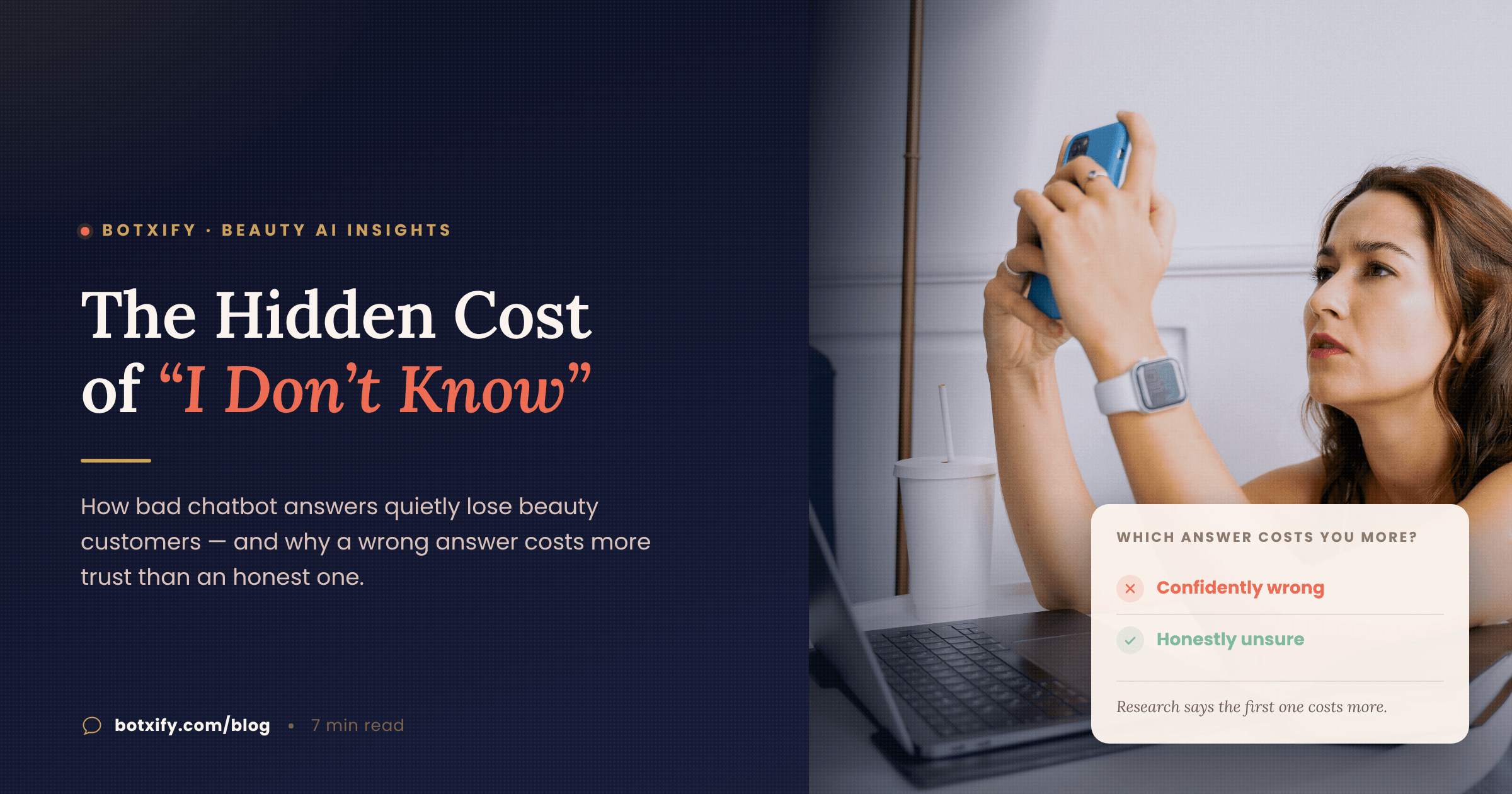
A 2026 academic study published in the Journal of Travel Research (Belanche, Casaló & Flavián) ran two controlled experiments — 232 and 225 participants — specifically comparing how customers react to an AI agent's plausible-but-fabricated answers ("hallucinations") versus its ordinary mistakes or failures to help. The finding: hallucinations damaged loyalty and generated more negative word-of-mouth than regular service failures did — customers reacted more harshly to being confidently misled than to being told, in effect, "I can't help with that." The researchers frame it as a violation of what people implicitly expect from an AI system in the first place: getting it wrong is forgivable, but getting it wrong while sounding certain reads as something closer to being lied to. (Journal of Travel Research, June 2026; note the study's context is service AI broadly, not beauty ecommerce specifically — the finding is about how people react to AI-agent failure in general, and there's no reason to expect beauty shoppers react differently.)
Put plainly: a system that says "I don't have that information" is doing the less damaging of two possible wrong things. The bar an AI advisor actually needs to clear isn't "never say I don't know" — it's "never sound certain about something it made up."
What "answers from your actual catalog" really requires
This is the part where it would be easy to overclaim, so here's the honest version instead. An AI advisor can only answer a formulation question — ingredients, whether something is fragrance-free, whether two actives are safe to layer — if that information actually exists in the store's own product catalog. That sounds obvious written out, but it's the detail most pitches skip past.
We checked this directly rather than assume it: across a sample of real catalogs on this platform, one had ingredient data on the large majority of its products; three others had none at all. That's not a claim about every store everywhere — coverage depends entirely on whether a merchant's product pages ever listed ingredients to begin with, and whether that data was successfully captured during catalog setup. A store whose product pages never listed ingredients has nothing for any AI system to draw on, and no vendor's pitch changes that.
What a well-built system can actually promise is narrower and more defensible than "knows your ingredients": it can promise to tell a shopper the truth about what it does and doesn't have — including saying, plainly, "I don't have the full ingredient list for this one" instead of guessing — rather than inventing a plausible-sounding answer to avoid an awkward gap. That's the version of "no generic non-answers" worth actually claiming: not omniscience, but the discipline not to fabricate when the real answer is "I don't know, but here's what I can tell you." Given what the research above shows about which failure actually costs more trust, that discipline is the one worth building for — and it's the standard Botxify is built against, including the parts of a catalog where the honest answer is still "I don't have that."
FAQ
Is it worse for a chatbot to say "I don't know" or to give a wrong answer?
Research on AI service failures (Belanche, Casaló & Flavián, 2026) found that confidently wrong answers ("hallucinations") damage customer loyalty and generate more negative word-of-mouth than an honest failure to help. A wrong answer costs more trust than an admitted gap.
Do shoppers really switch brands over one bad chatbot experience?
A 2024 Acquire BPO survey found 70% of consumers said they'd consider switching to a different brand after just one bad AI chatbot experience — a figure still widely cited in 2026 coverage of AI customer service.
Can an AI advisor always answer ingredient or formulation questions?
Only if that data exists in the store's own catalog. Coverage varies significantly store to store — some catalogs have ingredient data on nearly every product, others have none, depending on whether the merchant's product pages ever listed it.
What should a beauty store actually expect from an AI advisor's honesty?
Not that it knows everything — that it doesn't invent an answer when it doesn't. The more useful standard is whether it tells you what it doesn't know, rather than whether it claims to know everything.
Curious what an honest "I don't know, but here's what I do know" sounds like on your own catalog? Try Botxify free.