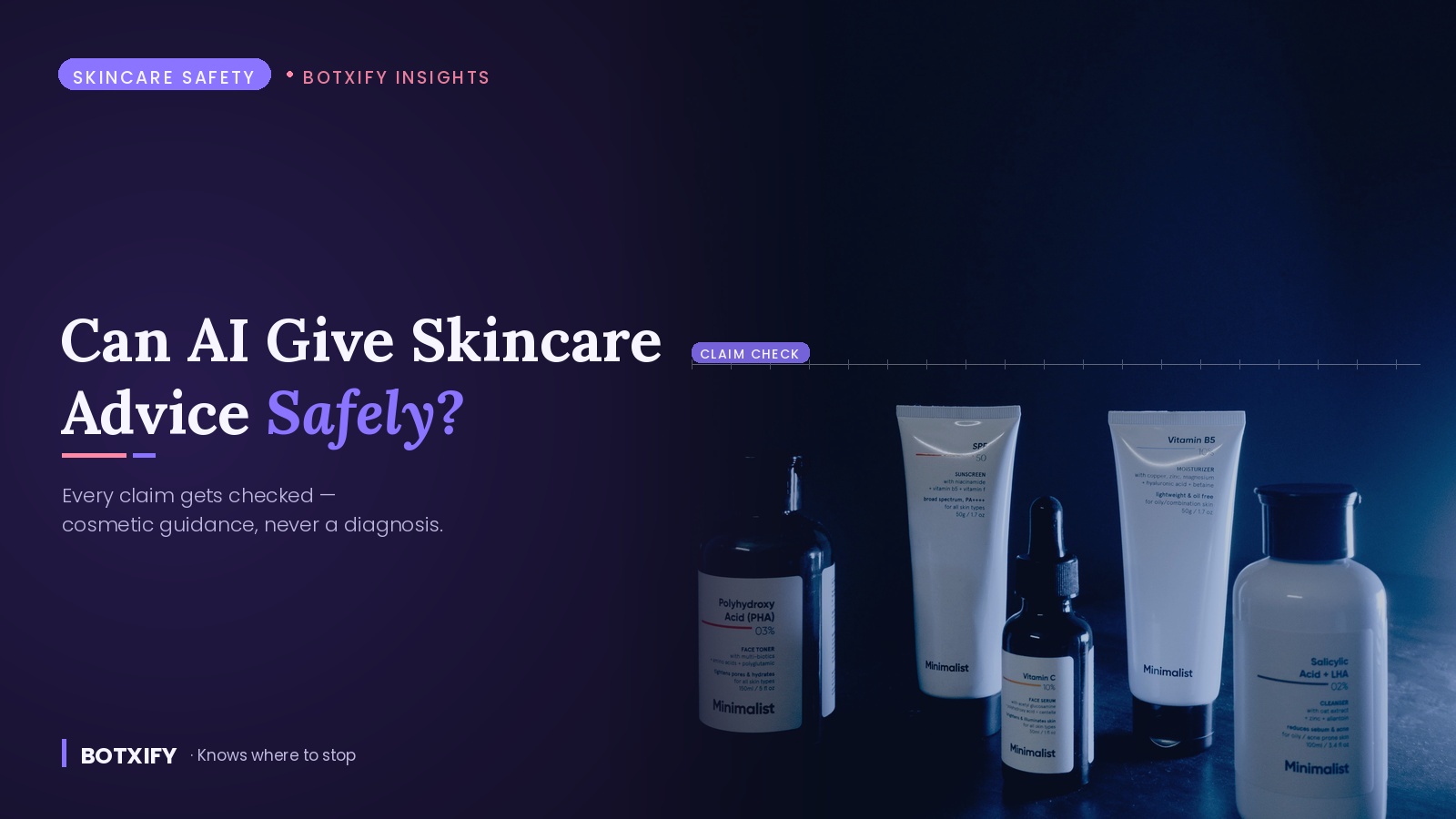
Can AI Give Skincare Advice Safely? Where Cosmetic Guidance Ends and Medical Advice Begins
If you're a beauty founder considering an AI advisor for your store, there's a question worth asking before any question about conversion rate: what happens the first time a shopper asks it something that isn't really a shopping question? "Is this safe for eczema." "I'm pregnant, can I use retinol." "My toddler put this on, should I worry." Those aren't edge cases in a skincare or personal-care store — they're a predictable fraction of every week's conversations, and how a system handles them says more about whether it belongs on your storefront than any conversion number.
This is the boundary a careful founder, or their legal counsel, should actually be asking about: not "does the AI sound knowledgeable," but "does it know where to stop."
The line founders (and their lawyers) actually worry about
The line itself isn't invented for AI — it's the same one cosmetics regulation has drawn for decades. Under the U.S. Federal Food, Drug, and Cosmetic Act, a cosmetic is something intended to cleanse, beautify, or alter appearance; a drug is something intended to diagnose, cure, mitigate, treat, or prevent disease, or to affect the body's structure or function. The FDA is explicit that the deciding factor is intended use — what the product, or the claim made about it, says it will do. (FDA — "Is It a Cosmetic, a Drug, or Both?") An anti-dandruff shampoo is regulated as both, because "cleanses hair" and "treats dandruff" are two different claims living on the same bottle.
An AI advisor makes claims too, out loud, in real time, to a real shopper. "This moisturizer is great for oily skin" is a cosmetic-shaped statement. "This will clear up your eczema" is a drug-shaped statement wearing a shopping assistant's voice — and it's the kind of line an LLM can cross without anyone deciding it should, because nothing stops it from sounding equally confident about both.
What "cosmetic guidance" can responsibly say
Responsibly scoped guidance sounds like a good in-store consultant, not a diagnostician: "here's a gentler option if your skin has felt reactive lately," "this one's formulated for combination skin," "a lot of people layering retinol pair it with this because it's less drying." Recommendation, comparison, and routine-building — cosmetic claims about cosmetic products, grounded in what the shopper said and what's actually on the shelf.
What it should never say — and why that's a design decision, not a limitation
It's worth being blunt about why this matters right now: general-purpose AI chatbots have already caused real harm by answering health questions they were never built to gate. ECRI, the nonprofit patient-safety organization, named misuse of AI chatbots in healthcare the top health technology hazard for 2026, citing cases of incorrect diagnoses, unnecessary-testing recommendations, and confidently invented medical details. (FierceHealthcare, 2026.) A lawsuit filed in San Francisco County Superior Court in July 2026 alleges that a general-purpose chatbot told a person experiencing dizziness and unstable blood pressure to stay "recliner-bound" and that he'd need "eight to ten more episodes" before it was worth worrying about — he was later hospitalized for a pulmonary embolism his own doctors linked to the prolonged immobility the chatbot recommended. (Forbes, 2026-07-26.)
That's not a skincare example, but it's the exact failure mode a beauty advisor has to be built to refuse: a general-purpose model, asked something that sounds like a shopping question but is actually a health question, answering it fluently and wrongly because nothing in its design draws the line. Refusing to diagnose isn't a gap in capability — it's the one behavior that has to be non-negotiable, enforced the same way every time, not left to how a language model happens to feel about a given phrasing.
How this plays out when a shopper mentions an allergy or a skin condition
Concretely, here's what a hard-coded version of that boundary looks like, described plainly rather than as a feature list: when a shopper's message states a condition — pregnancy, a young child's age, broken or sunburnt skin, a past reaction to hair dye — and it's paired with a genuinely relevant product category, the system is built to stop short of affirming safety. It doesn't diagnose, it doesn't contradict a doctor's instructions, and it doesn't dose-advise. It says, plainly, that this is a question for a doctor, dentist, or pharmacist, and — because a safety deferral that just stops the conversation is its own kind of failure — it offers to keep helping with what it can actually judge, like showing what the store stocks for sensitive skin.
Two things about that design are worth being explicit about, because they're the parts a legal read would actually check: the condition has to be stated by the shopper, not guessed at from something adjacent they said — no health condition gets inferred. And the rule errs toward caution on purpose: a false "please check with a doctor" costs a slightly less smooth conversation; a missed one risks affirming something unsafe. Between those two costs, the system is built to take the cheaper one every time.
What we do — including the current limits
This is where it's worth being honest about a real gap that existed until recently, because the beauty industry's whole selling point is being able to say "here's what's actually in this and why it matters for you" — and that only works if ingredient data reaches the conversation at all. Ingredient lists live inside a broader "attributes" bundle that also holds lower-confidence, AI-inferred guesses (skin type, scent family, and similar). For a period, the two were scored together, and the ingredient list — scraped verbatim off the product page, a fact rather than a guess — got held to the same confidence bar as the inferred guesses next to it and quietly dropped from what reached the conversation on products that didn't clear it. That's since been corrected: ingredient data, when it's present in the source catalog, ships on its own, independent of that confidence score, specifically so a factual list isn't hidden behind a guess's uncertainty.
The honest caveat is about coverage, not the mechanism: this only works when a store's own product pages actually list ingredients in the first place. A catalog where ingredients were never entered or scraped has nothing to surface, no matter how the gating works — that's a data question for each store, not something any advisor can promise around.
One more thing worth stating plainly, because it's the kind of detail a careful founder should ask about directly rather than assume: today, this boundary is enforced in the conversation itself, turn by turn, when a relevant question comes up — not as a standing disclaimer banner printed above the chat window. If your brand or your legal counsel wants a persistent "this is not medical advice" notice visible in the widget itself, that's a design addition to make explicitly, not something to assume is already there. Botxify's medical-boundary behavior is built this way — deterministic, pack-defined, and reviewed like safety-critical data because that's what it is — but a chat-level safeguard and a visible legal disclaimer are two different things, and a store shouldn't rely on one to stand in for the other.
FAQ
Where's the legal line between cosmetic advice and medical advice?
Under U.S. law (FD&C Act), it comes down to intended use: cosmetic claims are about cleansing, beautifying, or appearance; drug claims are about diagnosing, treating, curing, or preventing disease, or affecting how the body functions. The same product — even the same conversation — can cross that line depending on what's claimed, not just what's sold.
Have AI chatbots actually caused harm by giving medical advice?
Yes. ECRI named AI chatbot misuse in healthcare the top health technology hazard of 2026, and a July 2026 lawsuit alleges a general-purpose chatbot's advice contributed to a delayed diagnosis of a serious blood clot.
Does an AI shopping advisor diagnose skin conditions?
It shouldn't, and a properly built one is designed not to — refusing to diagnose, defer to a professional, and never contradict medical guidance should be non-negotiable behavior, not something left to a language model's judgment call on a given phrasing.
Does the bot always know a product's full ingredient list?
Only when the store's own catalog has that data. The system is built to surface ingredient information whenever a store has published it — but it can't know what was never listed on the product page to begin with.
Want to see how a safety-first advisor actually talks to your shoppers? Try Botxify free.