Skin Type vs. Skin Concern: Why Most Beauty Quizzes Get Personalization Wrong
"Take our skin quiz!" is one of the most common calls-to-action in beauty ecommerce, and it's built on an assumption that doesn't hold up: that skin fits neatly into one of four or five boxes, chosen once, at the start of the relationship. A lot of real skin doesn't work that way — and the shoppers living in that gap are the ones a quiz serves worst.
The quiz problem — one axis, forced choice
Most skincare quizzes ask a version of the same question early on: oily, dry, combination, or normal — pick one. It's a reasonable starting point, and it's also a forced choice on an axis that doesn't capture everything dermatologists actually track. The quiz format itself is the constraint: a multiple-choice flow has to resolve to a fixed set of outcomes to route a shopper to a fixed set of product bundles, so anything that doesn't fit one of the boxes gets rounded off to whichever box is closest.
Why "oily" and "dehydrated" aren't opposites
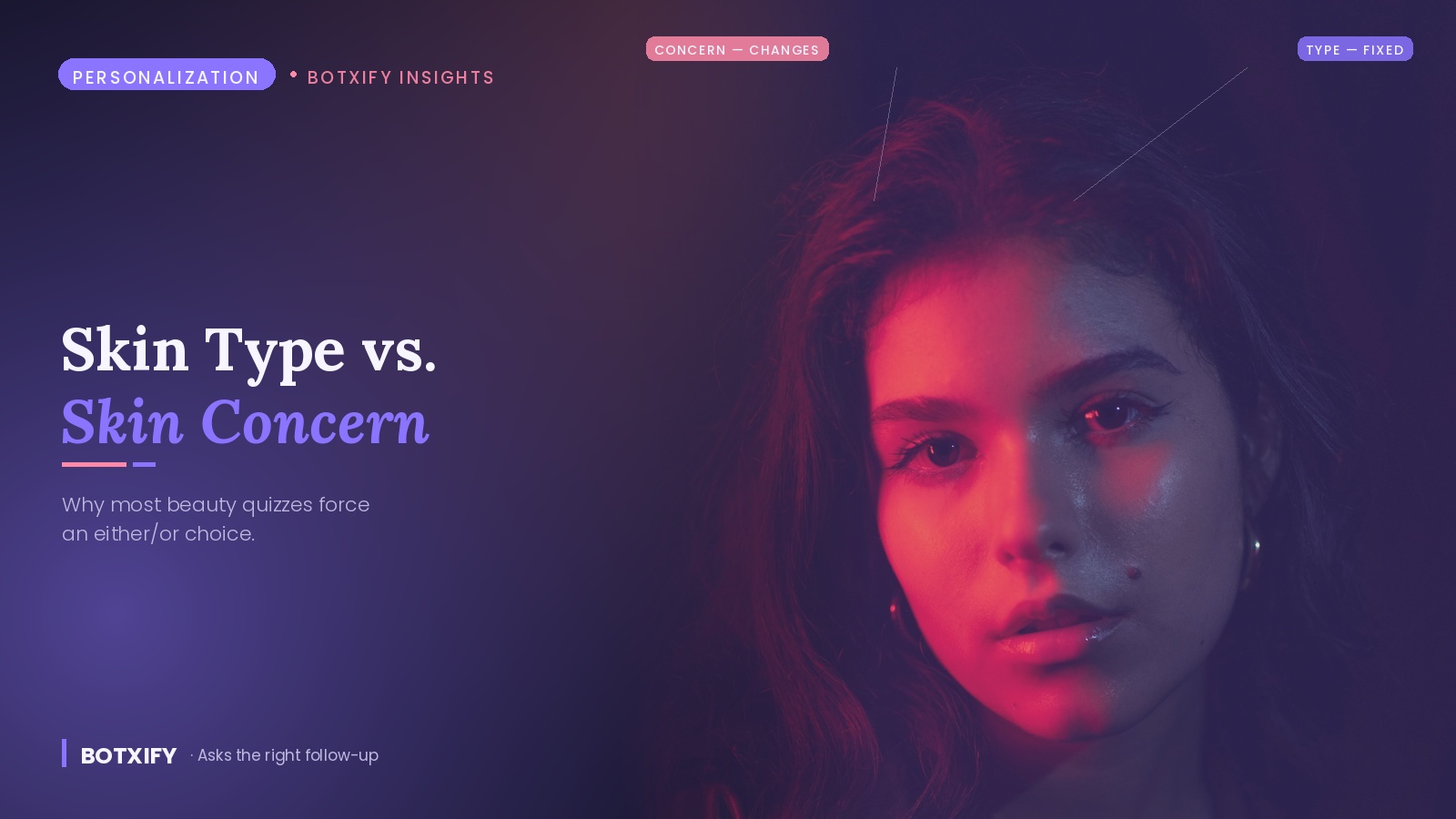
Here's the nuance most single-axis quizzes flatten: skin type and skin condition are two different things, on two different axes, and a quiz that only asks about one is only getting half the picture.
Dry skin is a type — a relatively stable, largely genetic trait about how much oil (sebum) skin produces on its own. Dehydration is a condition — a temporary state about how much water skin is holding, which has almost nothing to do with oil production and can affect any skin type, including oily skin. A dermatology practice explaining the distinction puts it plainly: dehydrated skin lacks water, not oil, and that's exactly why oily skin can be dehydrated at the same time — the oiliness doesn't cancel out the dehydration, and in some cases the dehydration actually triggers more oil production as skin tries to compensate. (Schweiger Dermatology Group.)
Put a name to it and the quiz problem gets concrete: "oily and dehydrated" isn't a contradiction a shopper is confused about — it's an accurate description of a real, common state that most "pick one" quizzes have no box for. The person gets routed to oil-control products that can make the dehydration worse, or hydrating products that don't address the oil, because the quiz's data model only had room for one axis.
It's not a fringe case, either. Combination skin — which by definition has more than one thing going on across the face — is reported by dermatology sources as the most commonly self-identified skin type, ahead of oily, dry, or normal alone, and there's peer-reviewed dermatology research specifically proposing a formal clinical definition for it because the category is real but has historically been vaguely defined. (PubMed — "Regional and seasonal variations in facial sebum secretions: a proposal for the definition of combination skin type".) If the most common answer is already a compound one, a quiz built around single, clean categories is misserving the majority, not an edge case.
What a static quiz can't do: follow up
The deeper issue isn't the categories themselves — it's that a quiz is a one-shot form. It asks its fixed set of questions once, in a fixed order, and then commits to an answer. There's no version of "wait, tell me more about that" in a multiple-choice flow. If a shopper's honest answer is "kind of both, depending on the week," the quiz has nowhere to put that, because the format was never built to ask a second question in response to a first answer.
That's the actual argument for a conversational approach, and it's a narrower, more specific claim than "AI is smarter": a follow-up question is possible in conversation and structurally impossible in a fixed-form quiz. "You mentioned feeling oily by midday but tight after cleansing — does your skin ever feel dehydrated even when it looks shiny?" is a question a quiz format cannot ask, because it depends on an answer the quiz already collected. A conversation can hold that thread; a form resets to its next fixed field.
What conversational personalization looks like when it works — and where it can still go wrong
To be specific about what "conversational, not a quiz" actually requires in practice: the system has to be willing to say it doesn't know something rather than guess, because a wrong guess stated confidently is worse than a quiz's forced-choice box — at least the quiz result feels tentative. A shopper who says "something for my dark circles" hasn't stated a skin type at all, and the honest response is to treat it as genuinely unknown rather than infer one from the product category. Getting that distinction wrong is a real failure mode, not a hypothetical one — a system that infers too eagerly can lock in a wrong assumption from one ambiguous message and then quietly filter every later suggestion around it, which is arguably worse than a quiz, because a quiz result is at least visible and correctable, while a bad silent inference isn't.
The honest design answer to that risk is to keep the two kinds of fact visibly separate: what a shopper has actually said gets treated as fact, and anything the system is inferring rather than being told gets held as a hypothesis to confirm — never blended into the same bucket, and never allowed to override something the shopper states outright, including "no" to a question. That discipline is precisely what Botxify's perception layer does today: skin type and similar decision-grade attributes are extracted "when stated or clearly implied," explicitly set to unknown rather than guessed when a message only implies an audience, a use case, or a budget, and unknown is treated as a correct, useful answer — it's what triggers one clarifying question instead of a wrong assumption compounding through the rest of the conversation.
FAQ
Are skin type and skin concern the same thing?
No. Skin type (oily, dry, combination, normal) describes fairly stable, largely genetic oil production. Skin concern or condition — dehydration, sensitivity, breakouts — describes a temporary state that can affect any skin type, including oily skin.
Can skin be oily and dehydrated at the same time?
Yes. Dehydration is about water, not oil, so it's independent of skin type and can occur alongside oily skin — dermatologists describe this as a genuinely common combination, not a contradiction.
Why do skincare quizzes often feel inaccurate?
Most are built as one-shot, single-axis forms: pick one type from a fixed list, get routed to a fixed bundle. They can't ask a follow-up based on what you just said, so a shopper whose skin doesn't fit one clean box gets rounded to the nearest one.
Is combination skin actually common, or a fallback category?
Dermatology sources report it as the most commonly self-identified skin type, and there's published dermatology research proposing a formal definition for it — it's a recognized, common category, not a "none of the above" bucket.
Curious what a follow-up-driven conversation looks like instead of a quiz? Try Botxify free.