Beauty Ecommerce AI Statistics 2026: What Every Skincare & Haircare Founder Should Know
Most "AI ecommerce statistics" roundups are the same six numbers, copied from blog to blog until nobody remembers where they came from. That's not useful if you're actually deciding whether to put an AI advisor on your skincare or haircare store. So this is a shorter list than most — every number here traces back to a named source you can check yourself, and a few numbers we found repeated everywhere without a traceable source didn't make the cut.
Here's what the data actually says about beauty ecommerce and AI going into 2026 — and, just as importantly, what's still too thin to build a strategy on.
A quick note on method: every stat below comes from a named, dated source with a working link. Where different trackers disagreed on a number (this happens constantly with "AI in retail" roundups — the same uncited figure gets copied from blog to blog until it looks like consensus), we either picked the source with visible methodology or left the number out entirely. If you've seen a bigger, punchier version of one of these stats elsewhere, that's usually why it's missing here.
Why beauty is the sharpest edge of the AI-shopping trend
Beauty and personal care shoppers are unusually willing to let AI into the buying decision, and the traffic data backs that up in a way that's easy to miss if you're only watching your own store's numbers.
During the 2025 holiday season, traffic to U.S. retail sites referred by generative AI tools rose 693% year-over-year, according to Adobe Analytics' official holiday shopping report (published January 2026). That's not a beauty-specific number — it's retail-wide — but two details in the same report matter more than the headline: visitors arriving via generative AI converted 31% more often than visitors from other channels, and AI-driven revenue per visit was up 254% year-over-year. People arriving through an AI conversation weren't just browsing more; they were buying more once they got there.
Separately, Capital One Shopping's compiled 2026 AI Shopping research (last updated July 2026) puts consumer intent even higher: roughly 76% of consumers say they want AI-powered shopping assistants, and about 80% plan to use generative AI for shopping in 2026. Read that as directional rather than exact — it's a secondary compilation of public data, not a single controlled study — but the direction lines up with Adobe's traffic numbers. (Source.)
The cart abandonment problem is worse in beauty than the ecommerce average
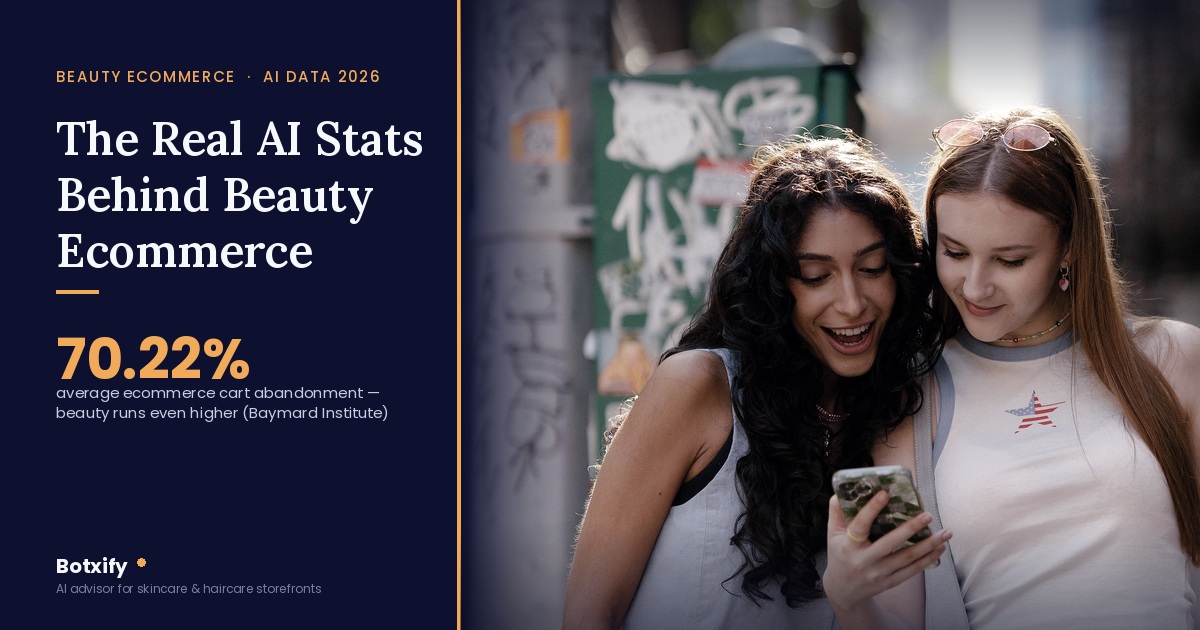
The most-cited baseline for cart abandonment comes from the Baymard Institute, which maintains a running meta-analysis of roughly 50 abandonment studies. Their current average across all of ecommerce: 70.22% of carts are abandoned before checkout.
Baymard doesn't break that number out by category, but multiple industry trackers that do report a category split consistently place beauty and personal care above the cross-category average — commonly cited in the 82–83% range, versus the low-to-mid 70s for ecommerce overall. The reason isn't mysterious if you sell beauty products: shade matching, skin-type fit, and ingredient sensitivity are exactly the kind of "will this actually work for me" hesitation that a static product page doesn't resolve, and a shopper who isn't sure just leaves instead of asking.
That gap — a few points above the ecommerce average — is arguably the single most concrete number in this whole roundup for a beauty founder: it's not that your shoppers are unusually indecisive, it's that your category asks more unanswered questions per product than most.
Worth being precise about what that gap does and doesn't prove: it's correlation, not a controlled experiment. Nobody has published a clean study isolating "unanswered product questions" as the cause of beauty's higher abandonment versus, say, price sensitivity or shade-matching anxiety specifically. But the categories that consistently top abandonment-by-vertical lists — beauty, apparel, furniture — share an obvious trait: fit and suitability are hard to judge from a photo and a spec sheet alone, and that's a harder problem for a static page to solve than for a conversation to solve.
Beauty shoppers are mobile-first, and they shop after hours
Two behavioral data points matter more than most "digital transformation" statistics, because they describe when and how your actual customers are showing up.
Mobile devices are forecast to account for 66.1% of global online beauty care sales in 2026, according to Statista's device-distribution forecast — meaning two out of three beauty purchases happen on a phone, not a desktop browser with a support tab open.
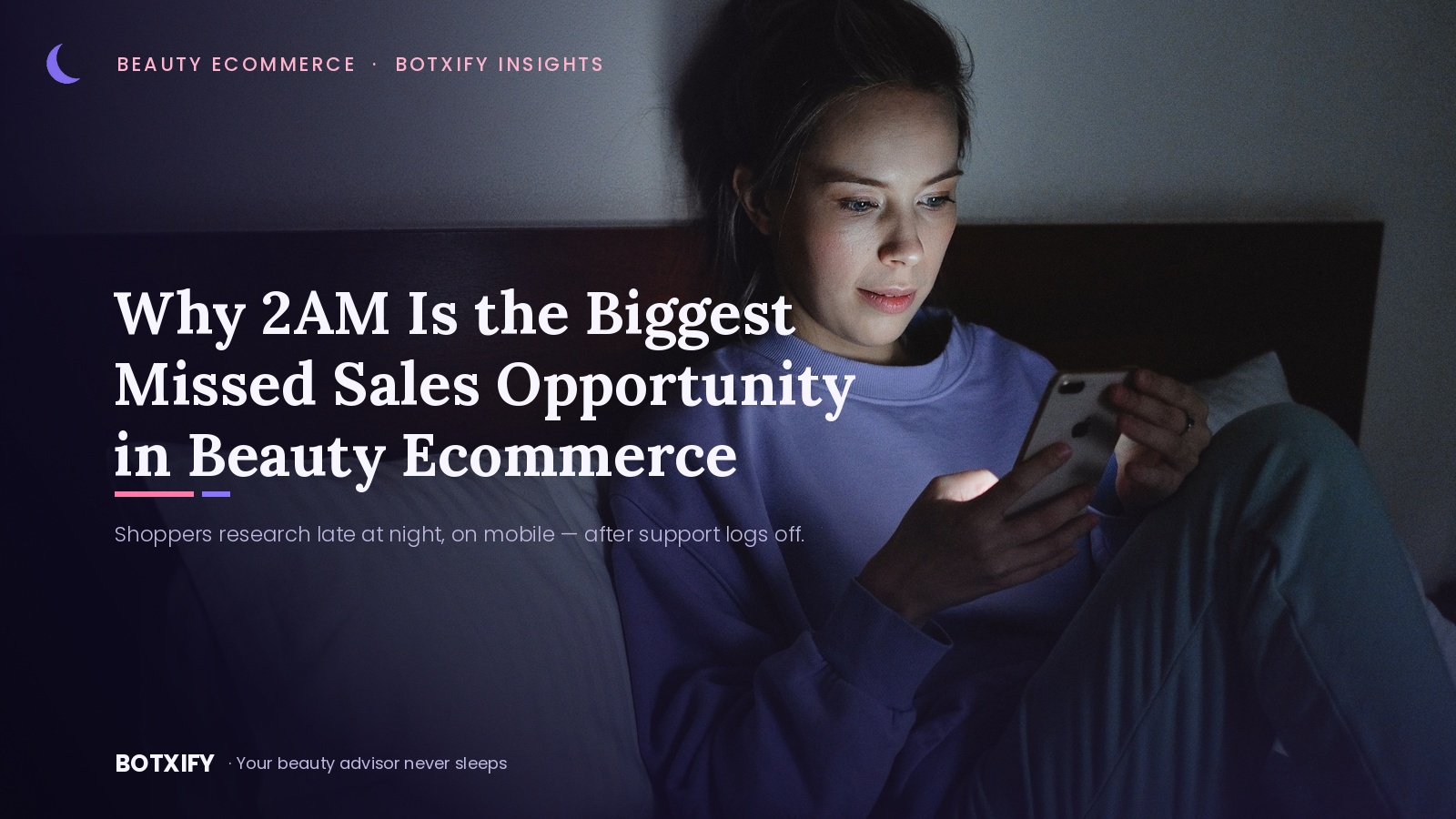
And a lot of that mobile activity happens late. A 2025 CouponFollow survey of U.S. shoppers found that 58% of Gen Z shoppers admit to making unplanned purchases specifically while shopping late at night, and when researchers asked what people actually bought during those sessions, beauty and personal care came in as the second most common category — behind only clothing and accessories. (CouponFollow research, covered by RetailBrew.) Put those two numbers together and the picture is plain: your highest-intent, most impulse-prone shopping moments are happening on a small screen, after your support team has gone home.
What this means if you're running a small-to-mid DTC beauty store
None of this data says "add a chatbot and revenue goes up X%" — anyone who tells you a beauty store's exact expected lift from a single stat roundup is guessing, and you should be skeptical of anyone (including us) who claims otherwise without your own store's data behind it. What the numbers above actually support is narrower and more useful:
- Your category has more unresolved pre-purchase questions than ecommerce average, and that shows up directly in a higher abandonment rate.
- The moments where those questions get asked are increasingly mobile and increasingly after conventional support hours.
- Shoppers are already telling researchers they want AI in that gap — the adoption intent exists ahead of most stores' ability to serve it.
- Where AI-referred traffic has been measured at scale (Adobe's holiday data above), it converts better than average — but that's traffic arriving via AI tools like ChatGPT or Google's AI overviews, not necessarily traffic served by an on-site AI advisor. Those are related trends, not the same measurement, and it's worth keeping them separate when you're evaluating a vendor's pitch.
If you take one thing from this list into a planning conversation, make it this: the case for adding conversational AI to a beauty store isn't built on a promised percentage lift. It's built on the fact that your category's biggest friction point — "will this work for me" — is a question format, and right now most stores only have an answer format (a product page) to offer back.
That's the actual case for an AI advisor on a beauty store: not a promised conversion percentage, but a mismatch between when your shoppers show up with questions and when a human is available to answer them. Botxify is built around that specific gap — a conversational advisor that stays available on your storefront and in DMs when your team isn't — but the stats above stand on their own regardless of which tool you evaluate for it.
FAQ
What's the average cart abandonment rate in beauty ecommerce?
The cross-industry ecommerce average is 70.22% (Baymard Institute, 2025). Beauty and personal care is commonly reported above that average, in the low-to-mid 80s, by trackers that break results out by category.
How much of beauty ecommerce traffic is mobile?
Statista's 2026 forecast puts mobile at 66.1% of global online beauty care sales — roughly two-thirds of purchases.
Is AI-referred shopping traffic actually converting, or just browsing?
According to Adobe Analytics' January 2026 holiday report, shoppers arriving via generative AI referrals converted 31% more often than shoppers from other channels, with revenue per visit up 254% year-over-year.
Do beauty shoppers really buy late at night?
A 2025 CouponFollow survey found 58% of Gen Z shoppers report unplanned late-night purchases, with beauty and personal care as the second most common category bought during those sessions.
Curious what an always-on advisor looks like on a beauty storefront? Try Botxify free and see it on your own catalog.