From Browser to Buyer: How Conversational AI Reduces Choice Paralysis in Beauty Shopping
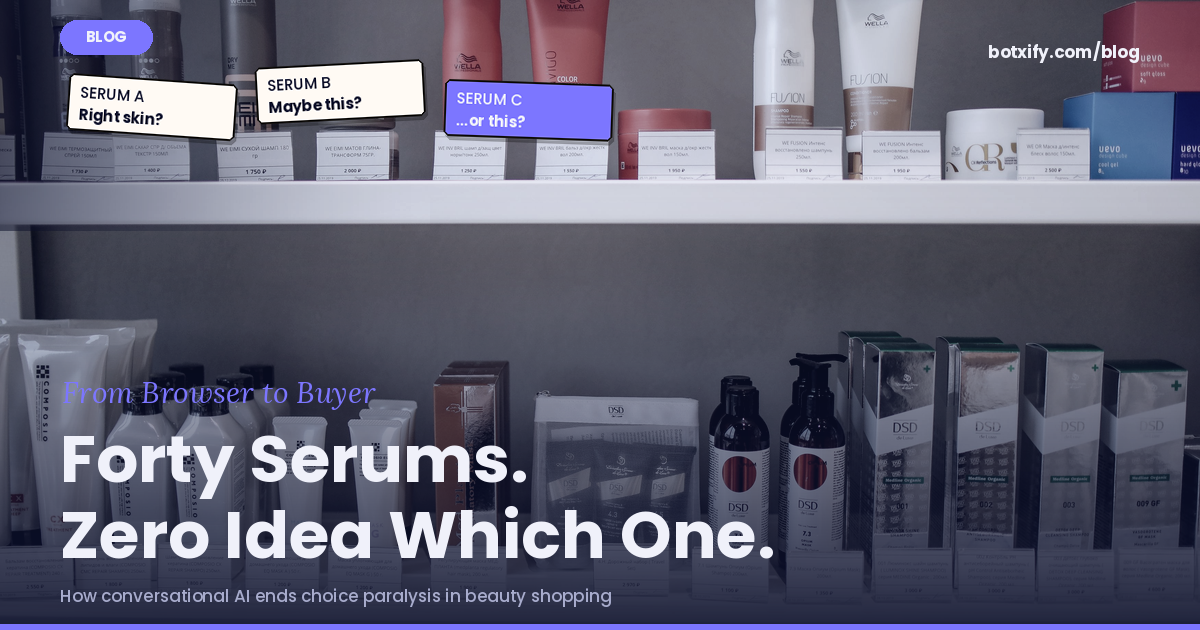
Open the serum category on almost any well-stocked beauty store and you'll find somewhere between twenty and eighty options, sorted by "best selling" or "newest" or, if you're lucky, "price: low to high." None of those sorts answer the only question the shopper actually has, which is: which one of these is for me. That gap — a full shelf, no way to tell — is where a browsing session quietly turns into a closed tab.
The 40-serums problem
This isn't a new observation about human decision-making, and it isn't specific to beauty — it's one of the more replicated findings in consumer psychology. In a well-known study by Sheena Iyengar and Mark Lepper, shoppers browsing a jam display were far more likely to stop and look when 24 varieties were on offer, but far more likely to actually buy when the display was cut down to 6: about 30% of shoppers purchased from the smaller display, versus roughly 3% from the larger one. More options drew a crowd; fewer options closed the sale. (Iyengar & Lepper, "When Choice is Demotivating," Journal of Personality and Social Psychology, 2000.)
Beauty shopping is close to a worst-case scenario for this effect, because the options aren't just numerous, they're genuinely hard to tell apart without expertise most shoppers don't have. A shelf of eight serums with different actives, percentages, and "for X skin" claims isn't twenty-four flavors of variety — it's twenty-four flavors of a decision the shopper doesn't feel qualified to make. Cart abandonment data backs up how often that decision just doesn't get made: the ecommerce-wide average sits at 70.22% (Baymard Institute), and beauty is consistently one of the categories reported above that average.
Why a filter grid doesn't actually solve it
The standard answer to "too many products" is more filters — skin type, concern, price range, ingredient. It helps, but it doesn't actually solve the underlying problem, because filters answer a different question than the one the shopper is stuck on. A filter narrows by what a product is: "oily skin," "under $30," "fragrance-free." It can't narrow by what's right for this specific person, because that requires knowing something about them a checkbox can't capture — how their skin has actually been behaving lately, what they've already tried and disliked, whether "oily" this week is really "oily and dehydrated." A shopper can tick every filter correctly and still be looking at eleven products with no way to choose between them, because the filters got her to the right neighborhood, not the right house.
What guided conversation changes — narrowing through dialogue, not just facets
The actual difference a conversation can make isn't "AI is smarter than a filter" — it's narrower and more mechanical than that: a conversation can ask a follow-up based on what was just said, and a filter panel can't. "You mentioned your skin gets oily by midday — does it also feel tight right after cleansing?" is a question that depends on an answer already given. No filter UI does that; it presents the same fixed set of checkboxes to everyone, in the same order, regardless of what's already been established.
What that looks like mechanically, described plainly rather than as a pitch: instead of returning every product that matches a set of filters, the system ranks the full catalog against what's actually been said in the conversation and returns a short list — the recommendation count is capped, by default between one and five products per turn, adjustable per merchant or by the shopper directly asking for "just one" or "a few options." That's a structural difference from a filter grid, which by design shows everything that matches, however many results that is.
Two things worth being honest about, because "narrows the catalog down" is an easy claim to overstate. First, narrowing only works if the underlying matching is accurate — a system that confidently returns the wrong five products has replaced one kind of overwhelm with a worse kind of wrong. Real regressions have happened in exactly this spot before: a badly scoped category match once returned haircare products for a skincare search, and a catalog with several same-title, different-price listings once let duplicates of the same product both reach the shortlist, defeating the whole point of narrowing. Both were real bugs, not hypotheticals, and both are the kind of thing that has to be checked continuously, not fixed once — the current approach deliberately avoids hard category filters that can zero out a result list entirely (a store with nothing for a stated audience should still show what it has, honestly, rather than show nothing), and de-duplicates by product title on every ranking pass rather than trusting each caller to remember to. Second, and more simply: a short, well-matched list is only better than a long one if it's actually well-matched — five confidently wrong products help nobody. Narrowing is only valuable in service of accuracy, not instead of it.
What this looks like in practice
Concretely, the shift from browsing to buying looks less like a recommendation engine and more like a conversation that remembers what it just learned: a shopper says she wants a serum, gets asked one clarifying thing rather than four, mentions her skin's actually oily and tight, and the next products shown reflect that combination rather than a single checkbox. It's a small number of turns, not a wizard with six screens — the goal is closer to how a good in-store consultant narrows a wall of product down to three worth trying, not a smarter filter sidebar.
FAQ
Is choice overload a real effect, or just a UX talking point?
It's a well-established finding in consumer psychology. The original Iyengar & Lepper jam study found a smaller, curated display converted roughly 10x better than a large one (about 30% vs. 3% purchase rate), and it's been replicated across many product categories since.
Don't filters already solve this?
Filters narrow by product attributes (skin type, price, ingredient) — they can't narrow by what's actually right for one specific shopper's situation, which usually requires a follow-up question a static filter panel can't ask.
How many products does a guided conversation actually show?
Typically a short list rather than everything that matches — by default between one and five per turn, adjustable per merchant, or by the shopper asking for more or fewer directly.
Is a shorter list always better?
Only if it's accurate. A short list of the wrong products is worse than a long list of roughly-right ones — narrowing only helps when the underlying matching is trustworthy.
Want to see a 40-product category narrowed down to what actually fits one shopper? Try Botxify free.